






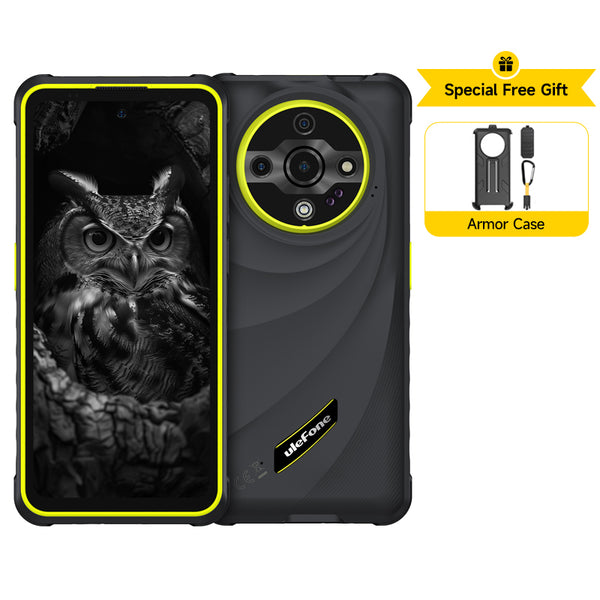
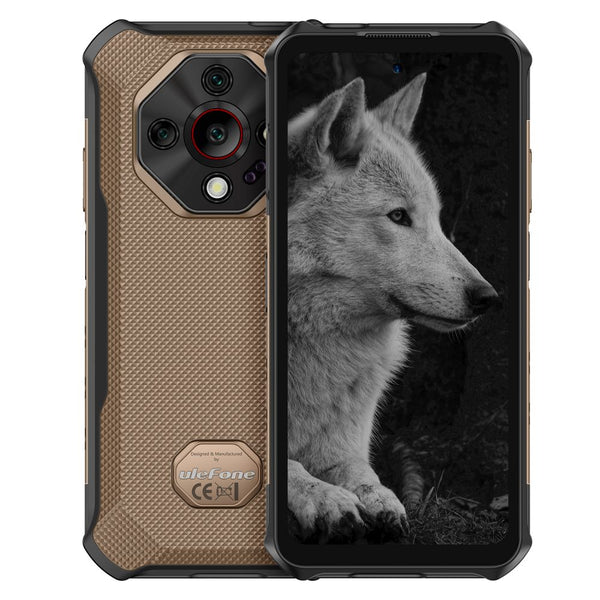
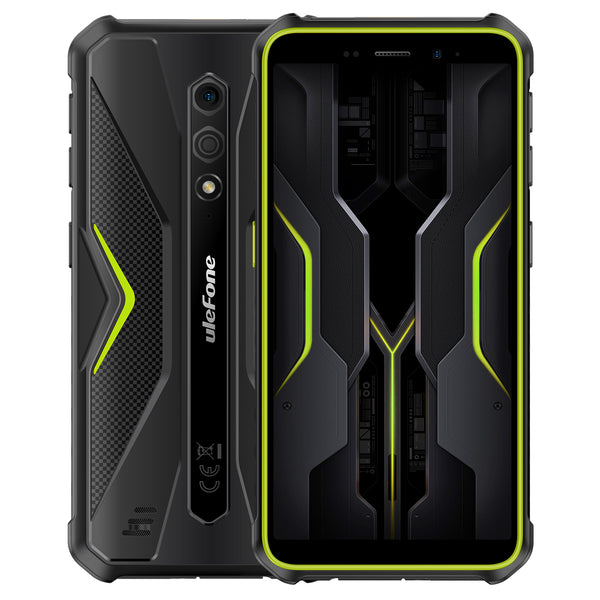
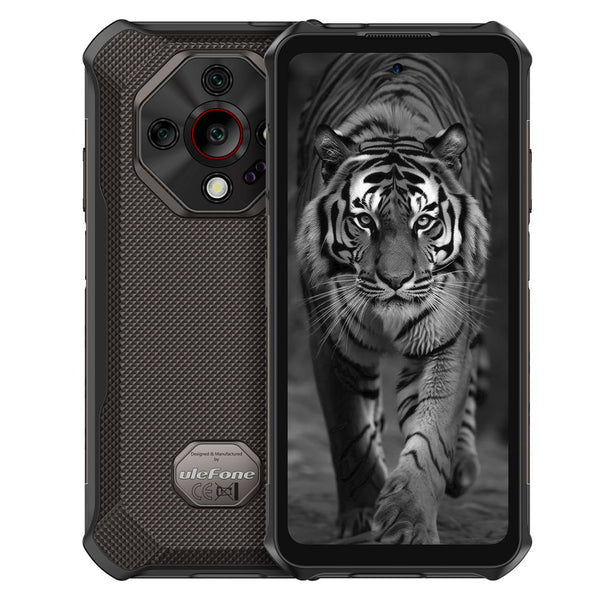










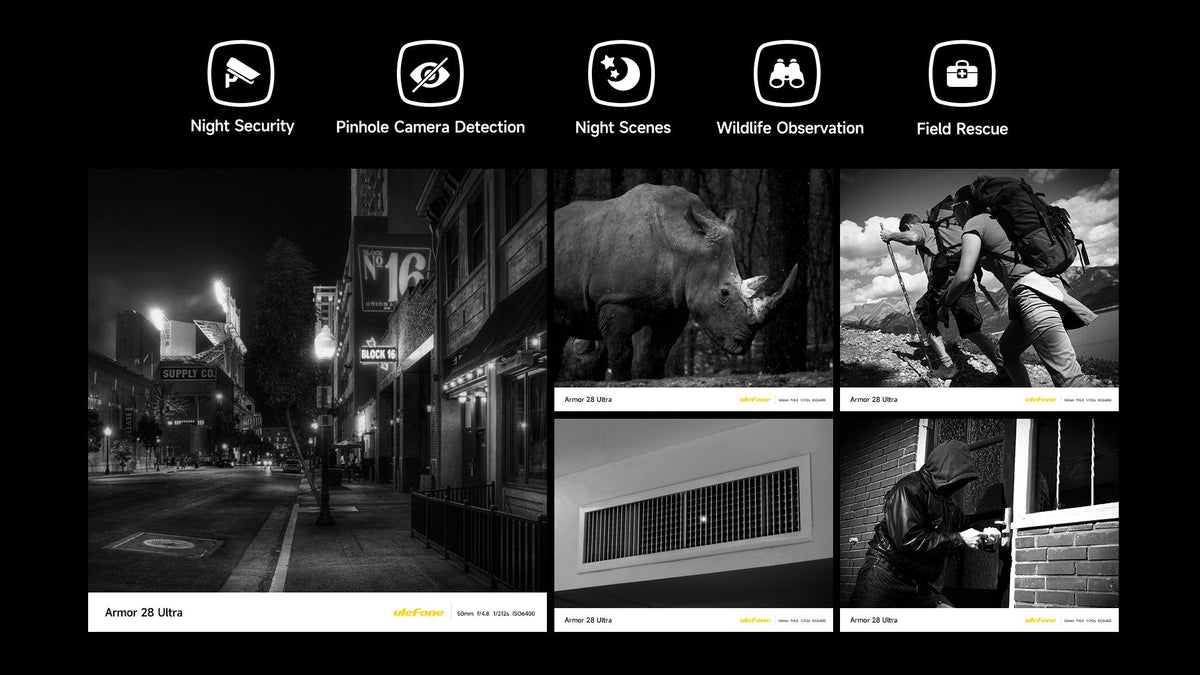
Night Vision Camera Phone What Is It and How It Works Imagine taking a perfectly sharp, detailed photo in a pitch-black room - not a guess at what’s there, but a crisp image of what’s really there. That’s what a night vision camera phone can do, and it’s quite different from the night mode found on a flagship camera phone. In this article, we tell you what a night vision camera phone is, how the tech works, how it’s different from regular night mode photography, who needs one, and what features to look for before buying.
In this article, we tell you what a night vision camera phone is, how the tech works, how it’s different from regular night mode photography, who needs one, and what features to look for before buying.
Does My Phone Already Have Night Vision?
Not the kind that works in a dark room. Your flagship’s night mode is software — it stacks frames of whatever ambient light exists and brightens the result. Give it a moonlit street and it does great. Give it a windowless basement and it has nothing to work with, because it still needs light.
This is also where the app stores muddy the water. Search “night vision” on the Play Store or App Store and you’ll get apps that throw a green tint over your camera feed and call it a night vision camera. They’re not detecting anything extra — the image is still visible light, just recolored.
There’s a physical reason no app can fix this: your main camera has a fixed IR-cut filter in front of the sensor. It blocks infrared so daylight shots look natural, and no software can remove it. Face ID on iPhones projects and reads IR dots for facial mapping, but that hardware is sealed to its own sensor and can’t capture a viewable image.
Real night vision needs dedicated parts: IR LEDs to illuminate the scene and an IR-sensitive camera that skips the IR-cut filter. That’s the hardware built into the rugged phones in this guide, and it’s the only reason they can show you a usable image in total darkness.
What Is a Night Vision Camera Phone?
A night vision camera phone is a normal smartphone that has a dedicated IR night vision camera (usually a 64MP sensor) with IR LEDs behind an IR filter. A normal camera that takes photos in poor light conditions needs light to create an image, but the dedicated night vision camera creates an image in near-zero or zero-light conditions by emitting a visible IR light to illuminate the scene and capturing reflected IR light on its sensor.
It’s not the same as a camera phone’s night mode, which uses computational low-light photography to create images. Night mode stacks multiple takes over time and uses data from a large sensor to deliver brighter pictures in dim moonlit conditions, not pitch-black ones. Night vision camera phones, on the other hand, do not rely on ambient light at all.
How Night Vision Works on a Phone
he three elements involved are:
1. Infrared LED lights are used to emit a visible IR beam onto the scene.
2. The dedicated night vision camera (ideally a 64MP sensor) registers the IR reflection; that could be in zero or very minimal light conditions.
3. Software (for example, Night Elf Ultra 3.0 on Ulefone models with multiple IR LEDs) turns that IR reflection into a bright monochrome or IR-tinted image. It also raises the overall brightness, cools the image temperature, and filters out noise.
The camera is integrated into a tough outdoor phone with no fragile accessory required. That means you can carry it into the woods, into crawl spaces, or into a crime scene without needing a separate scope or gimbal.

Night Vision Phone vs. Regular Phone Night Mode
|
|
Night Vision Phone |
Regular Phone Night Mode |
|
Light source |
Built-in IR LEDs |
Ambient light only |
|
Works in total darkness |
Yes |
No (needs ambient light) |
|
Image type |
IR-based monochrome and detail image |
Computational low-light color photo |
|
Typical hardware |
Dedicated IR camera + IR LED array |
Large sensor + multi-frame image stacking |
|
Best for |
Zero-light tasks: nighttime hunting, patrolling, wildlife photography, inspecting dark spaces |
Beautiful, lit city/night images |
If your intention is to take a usable picture in total darkness, only the first row applies. If you want beautiful, dark cityscape/night photos, a flagship’s night mode is the right tool. The two are vastly different products for different jobs, and you need to distinguish them as a potential buyer.
IR Night Vision vs. Thermal vs. Image Intensifier: Three Ways to See in the Dark
People search all three as if they were one product. They’re not — here’s the quick way to keep them straight:
|
|
IR night vision phone |
Thermal imaging |
Image intensifier (monocular / military-style) |
|
How it works |
IR LEDs light the scene; an IR-sensitive sensor captures the reflected light |
Detects the heat every object radiates |
Amplifies the tiny bit of ambient light available (moonlight, starlight) |
|
Needs light? |
No — it brings its own |
No — heat needs no light |
Yes — needs some light, or an add-on IR illuminator |
|
Works in total darkness |
Yes |
Yes |
No |
|
What the image looks like |
Monochrome or IR-tinted, detailed |
Color-mapped heat palette |
Green-tinted, natural-looking scene |
|
What it’s best for |
Seeing shapes and details in the dark |
Finding what’s warm: people, animals, hot spots |
Long-range observation in low light |
If you’re comparing specs across these three, compare the right rows. A night vision phone tells you what’s in the dark; thermal tells you what’s warm; an image intensifier makes a dim scene bright. They overlap in the search results far more than they do in the field.
Who Needs a Night Vision Camera Phone?
Hunters and outdoor users. Steady your rifle or flash the scope without flooding the scene with a flashlight.
Nature observers and campers. Spot and record animals at night from a safe distance, without disturbing the herd/pack/flock.
Security, patrol, and property teams. Check yard, gate, and building perimeter security in the dark; collect visual evidence during incidents.
Home inspectors and DIY homeowners. Check for issues such as rodents or pests, wiring, and leaks; ensure bird or rodent entry has been sealed.
Pet owners. Find a missing dog in the yard in the middle of the night; verify what your dog is doing in the yard at 2 a.m. (sales are through the roof in July).
What To Look For in a Night Vision Camera Phone
Range in meters, not lux. Effective range is the spec to compare, and most rugged night vision phones claim roughly 10–15 m of usable range. Prefer models that state the range in meters, and cross-check claims against real-world tests — measured range beats a marketing number. And ignore lux ratings on IR illuminators: lux measures visible light, so a lux figure on an IR light is marketing math you can’t even verify. The models that rank on specs are the ones giving you wavelength and range — “940nm, 15 m” — not lux.
IR LEDs and wavelength. More LEDs mean more light and more range — four beats two, and most current phones carry two to four. Wavelength decides how discreet you are: 850nm is brighter with a faint red glow visible to the eye, while 940nm is invisible but shorter-ranged. If you’re hunting or watching wildlife, the quieter 940nm is usually the smarter pick.
Night Vision Camera Resolution. 64MP is the current standard in this category — usually an OV64B-class sensor — and higher resolution means sharper detail, especially when you crop into a scene. Just don’t stop at the megapixel count; the processing behind it matters just as much.
Processing. With the right processing engine, a night vision camera offers as much detail as your phone camera’s IR mode, yet in complete darkness. Check the reviews for demo shots taken at night.
Night capture in photos and video. Photos are standard; night video is not. If you need it, confirm the night-video resolution and frame rate in the specs — night video is often capped lower than the main camera, and low frame rates smear when you pan.
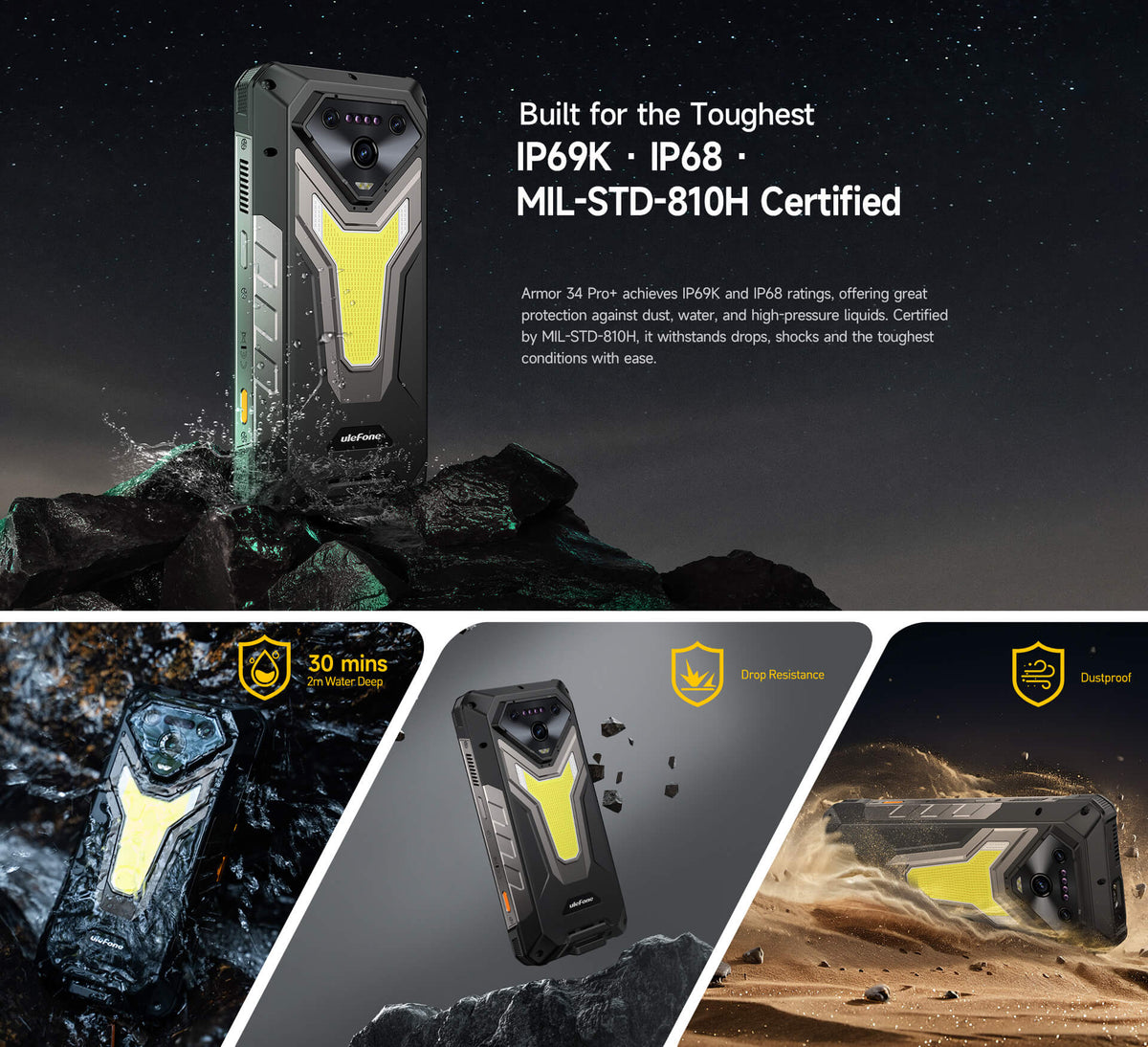
Ruggedness and battery life. Most work outside, in tight spaces, and in the rain; look for IP68/IP69K, MIL-STD-810H, and battery life over 10000mAh.
Optional combined thermal camera. Several phones also include a thermal sensor; see our full guide to thermal imaging phones.

Our Night Vision Phones: Armor 28 Ultra and Armor 34 Pro
If you’re looking for a dark-vision phone, you won’t go wrong with these two rugged models.
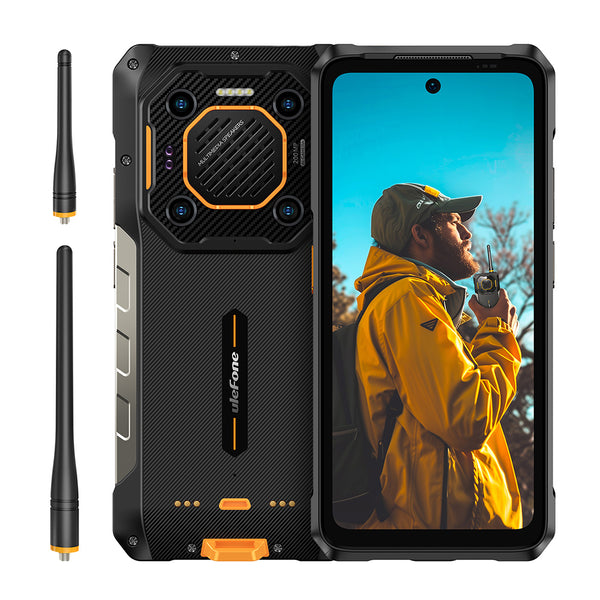
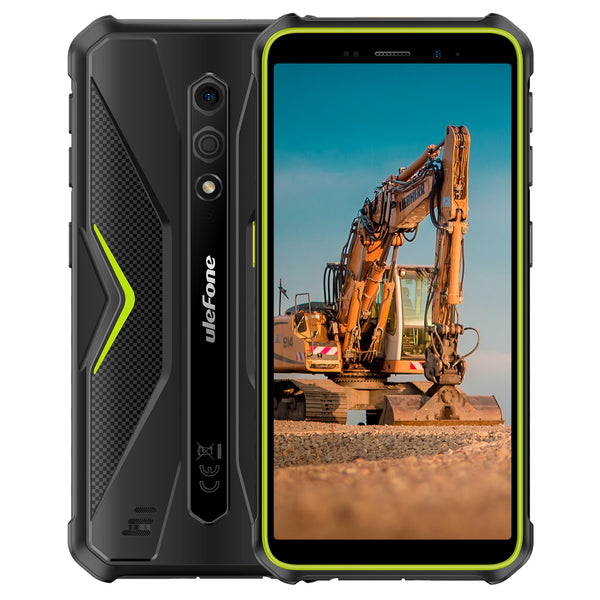
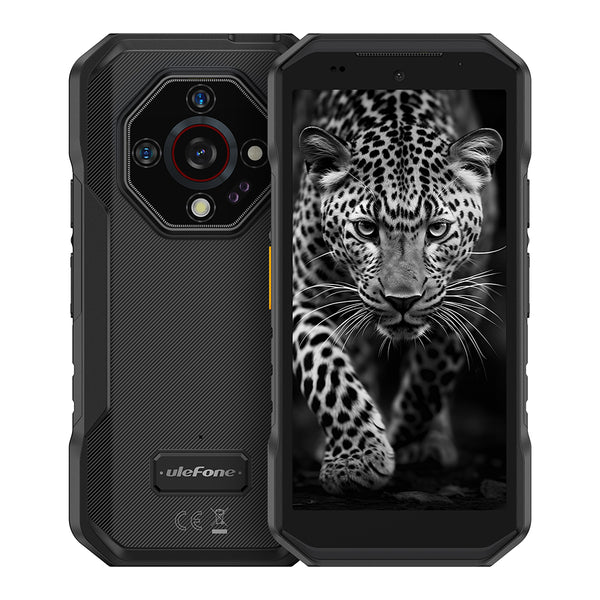
The Armor 28 Ultra packs a 64MP Night Elf Ultra 3.0 camera with 4 IR LEDs and a Dimensity 9300+ CPU in the same flagship rugged build as the Armor 28 with IP68/IP69K and MIL-STD-810H, plus a 10600mAh battery and 120W charging.
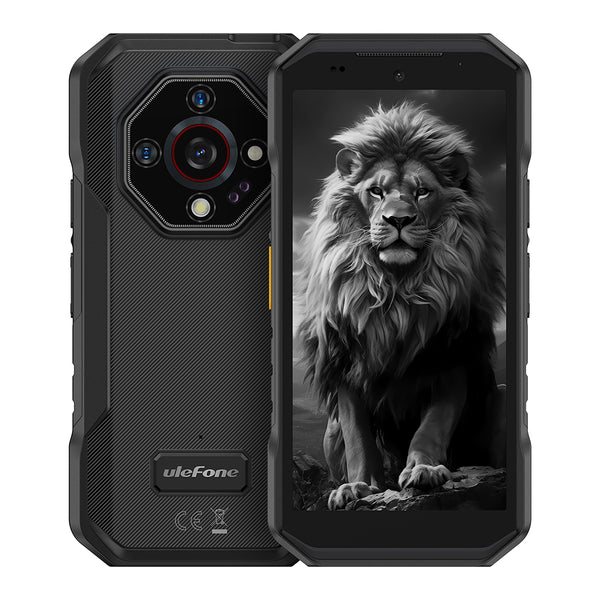
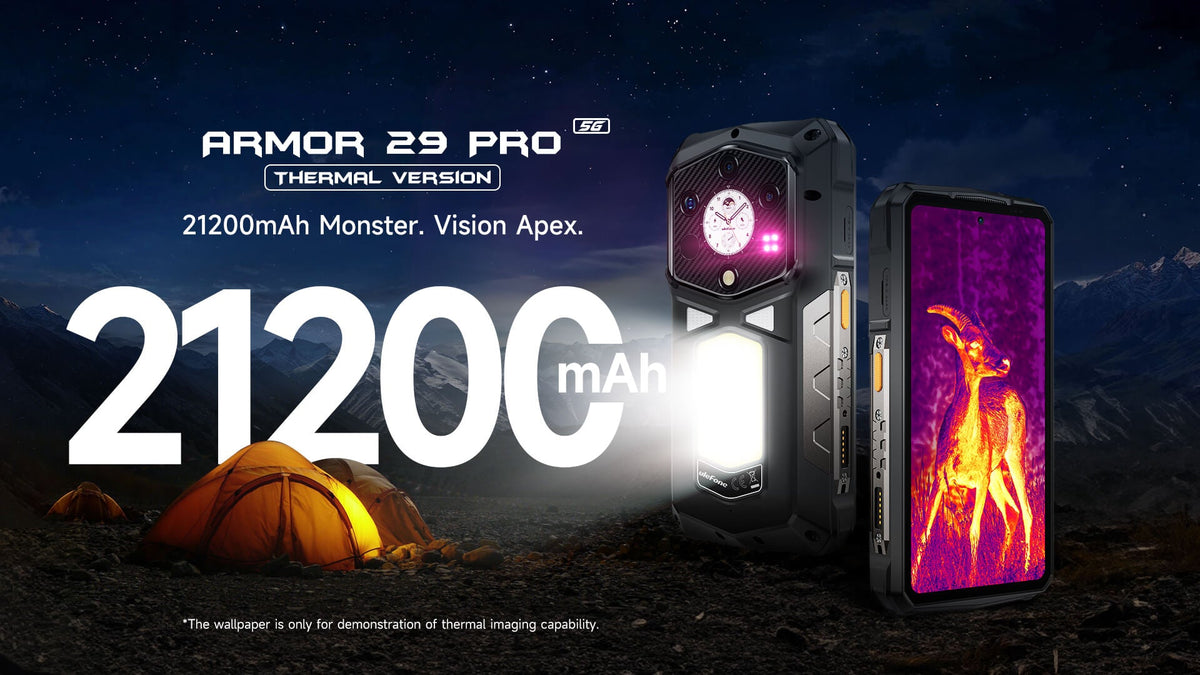
The Armor 34 Pro adds a huge 25,500mAh battery, a built-in projector, and a 50MP main camera to a similarly rugged IP68/IP69K/IP69K/IP69K and MIL-STD-810H model, with a 64MP night vision and IR LEDs to boot. Perfect for long nights in the field far from a power outlet.
They’re not the only ones in this space, so it’s worth seeing them next to the same-field competition:
|
Model |
Night vision setup |
Battery & extras |
Best for |
|
64MP Night Elf Ultra 3.0, 4 IR LEDs |
10600mAh, 120W charging, MIL-STD-810H |
Everyday pro use; cleanest image of the group |
|
|
64MP night vision + IR LEDs |
25,500mAh, built-in projector, 50MP main camera |
Long nights far from power |
|
|
64MP night vision, Night Elf processing |
Mid-range price, rugged build |
A first night vision phone without the flagship price |
|
|
Doogee TANK series |
64MP night vision on current models, 940nm IR, ~15 m claimed range |
Huge battery, rugged |
Buyers comparing wavelength and range on spec sheets |
On paper the 64MP sensors all look the same — the differences show up in the algorithm, the LED count, and what else is in the box. The Armor 28 Ultra’s Night Elf Ultra 3.0 engine with four IR LEDs produces the cleanest image of the group, while the 34 Pro trades some of that polish for a 25,500mAh battery and a built-in projector no competitor matches; the 27T Pro+ and Doogee TANK are the value plays if you mainly need the feature rather than the flagship extras.
Frequently Asked Questions
Is a night vision camera the same as a camera phone’s night mode?
No. The camera phone night mode is computational low-light photography that does not work in total darkness, while a night vision camera uses dedicated IR LEDs and a dedicated IR sensor to work in pitch darkness.
How far can a night vision camera see?
IR LED power and LED count determines the effective range; multiple LEDs mean the ability to see further. Look for range ratings from the manufacturer and check reviews for real-world opinions.
Can the night vision camera work indoors in total darkness?
Yes. Night vision is designed to work in total darkness.
Is night vision in color, and why do animal eyes glow?
Mostly no. Night vision images from dedicated IR sensors come out monochrome or IR-tinted — the sensor records reflected IR brightness, not color. If you need color at night, you need night mode with a large sensor and at least some ambient light. What you will see in real night vision is animal eyes glowing bright: the tapetum lucidum, a reflective layer behind many animals’ retinas, bounces IR straight back at the sensor. Eyes show up as glowing dots long before you can make out the body, which makes night vision oddly good at spotting deer, raccoons, or a dog that slipped out into the yard.
Which is better for security: a night vision phone or a security camera?
Security cameras are fixed and keep recording; a mobile phone is portable and multipurpose. Many security teams use phones to observe and gather evidence, and cameras to keep a site covered.
Does a night vision phone camera also function as a thermal camera?
No. They are two different sensors; one senses heat, one sees in the dark. See our guide to thermal imaging phones for detailed info.
Does iPhone or Samsung have a real night vision camera?
No. No mainstream flagship ships with a real night vision camera, and that means the hardware simply isn’t there — no IR LEDs, no IR-sensitive sensor. iPhone’s Face ID does project and read IR for facial mapping, but that’s locked to its own tiny sensor and can’t capture a usable photo or video. Samsung flagships don’t have the hardware either. Their night modes are computational low-light photography, which still needs ambient light. If you want true night vision on an iPhone or Samsung, the honest options are a clip-on IR camera or a rugged phone with the hardware built in.
Can a night vision app work without extra hardware?
No, and the app stores are full of apps that pretend otherwise. Your phone’s main camera has a fixed IR-cut filter in front of the sensor — it exists so daylight photos look natural, and no app can remove it. So-called “night vision” apps are green filters on the normal camera feed: they recolor and brighten what’s already there, but the camera is still only seeing visible light. A genuinely dark room stays black no matter how green you make it. Real night vision needs dedicated hardware — IR LEDs to light the scene and a sensor that can see that light.
Night mode vs IR night vision vs thermal imaging — what’s the difference?
Three different tools that people keep typing into the same search box. Night mode is software: it stacks multiple frames of ambient light to brighten a dim scene, and it fails in pitch black. IR night vision is hardware: LEDs light the scene and an IR-sensitive sensor records the reflection — works in total darkness, monochrome output. Thermal imaging is hardware too, but it reads heat emitted by objects instead of light, needs zero light, and shows temperature differences rather than a “scene”. Quick way to remember: night mode for city shots, night vision for “what’s in that dark room”, thermal for “what’s hot and where”.
850nm vs 940nm — which should I get?
It’s a tradeoff between brightness and concealment. 850nm LEDs are brighter and reach further, but they throw a faint red glow that a person or an animal can notice at close range. 940nm is invisible to the human eye, which keeps you more discreet — at the cost of some range. If you’re hunting or watching wildlife, 940nm is usually the better pick; for inspecting a crawlspace or a fence line, the extra punch of 850nm helps more. Check the spec sheet: most rugged phones state the wavelength openly, and models that market “940nm” are telling you they prioritized stealth.
Can I record night vision video?
On many models, yes — but check before you buy, because night video isn’t guaranteed. Some phones record night vision video at full resolution, others cap it around 1080p/30, and a few don’t offer it at all. Frame rate matters too: at low rates the image smears when you pan. If video is a requirement, look for the night-video resolution and frame rate in the specs, and watch real sample footage instead of trusting the marketing stills.
For hunting or security, how does a phone compare to an IR monocular or a fixed security camera — and is it legal?
Different jobs, and teams usually run more than one. A fixed camera records continuously and watches one spot; a night vision phone goes with you and doubles as an evidence-gathering tool. Against a dedicated IR monocular, the phone is usually cheaper and doubles as a camera, but a monocular typically offers more magnification and a longer effective range. The legal part you have to check yourself: hunting rules vary by region, and some places restrict or outright ban night vision and IR aids for hunting — night vision gear is also regulated or export-restricted in some countries. Look up the rules where you’ll actually use it before buying for that purpose.


Commenta
Nota che i commenti devono essere approvati prima di essere pubblicati.
Questo sito è protetto da hCaptcha e applica le Norme sulla privacy e i Termini di servizio di hCaptcha.